How to Add Water Heater + Whole-Home Repipe Service to Your Plumbing Business (2026 Guide)
Honest playbook for established plumbing service shops ready to shift the revenue mix toward high-ticket water heater installs ($1,500-$8,000 typical) and whole-home repipes ($4,000-$15,000+). The federal 25C credit died Dec 31, 2025 — but EPA's LCRI lead-pipe replacement mandate (compliance Nov 1, 2027) creates a multi-year repipe tailwind, and state HPWH rebates ($750 MA / $2,250 CO / $1,750+ WA) are stronger than the federal credit ever was.
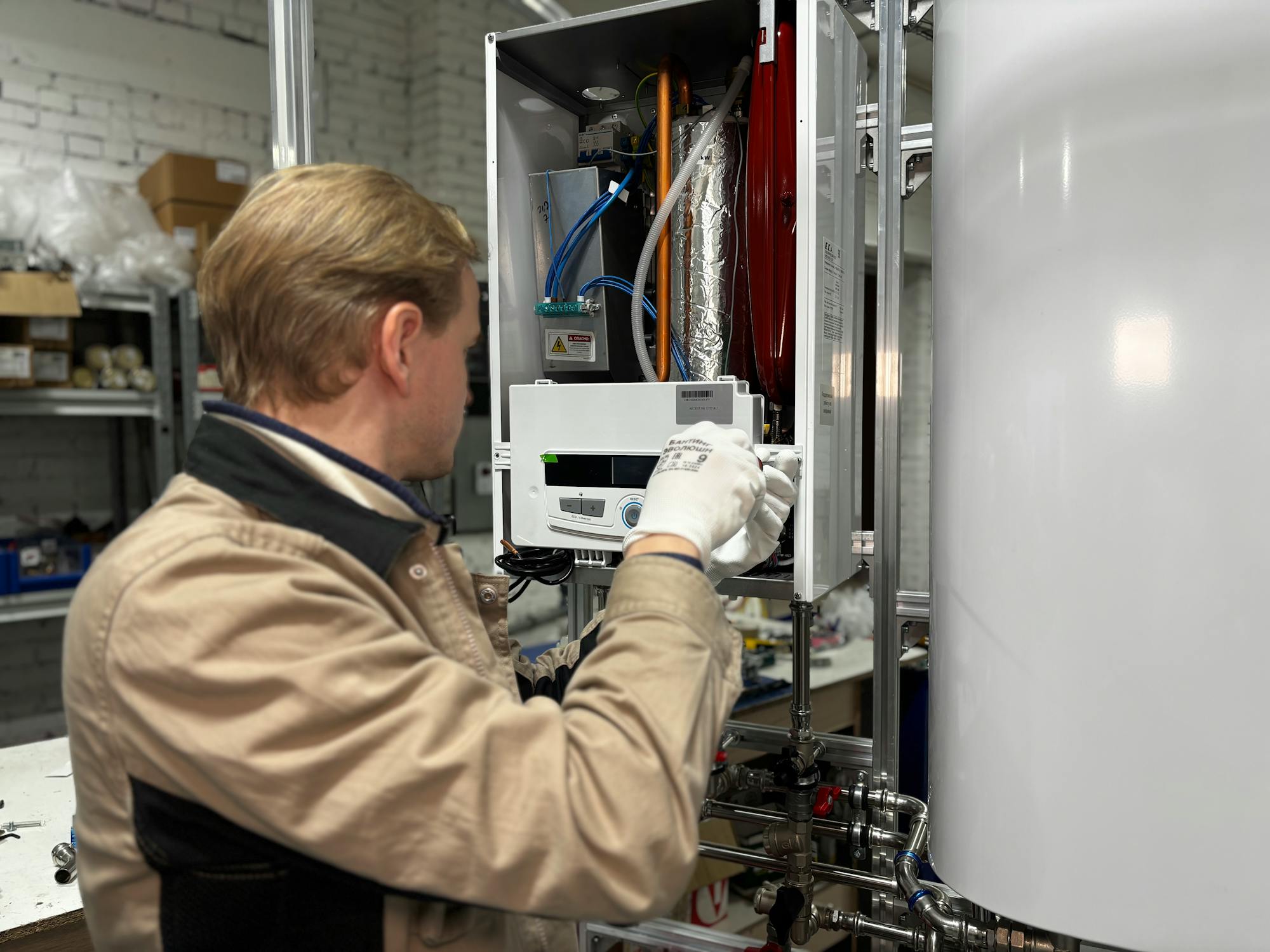
Plumbing service work has a hard revenue ceiling. A two-truck shop running drain cleaning + leak repair + small fixture work caps somewhere around $300K-$400K annually no matter how hard the techs work. The math: 6-10 service calls per day × $200-$500 average ticket × 240 working days × 2 trucks = ceiling. The shops that break through to $500K-$1M+ all do it the same way — they shift the revenue mix toward water heater replacement ($1,500-$8,000 per ticket) and whole-home repipe ($4,000-$15,000+ per ticket), where each completed job is worth 5-30 service-call tickets.
Like the HVAC service-to-install transition, the plumbing version has a counterintuitive economic reality: **service work has higher gross margin per dollar than install work**. FieldPulse's plumbing-business research puts gross margins at 60-65% with net 10-20% (15-20% considered healthy); installs typically run lower percentage margin but win on **ticket size + recurring tail + customer lifetime value**. A $4,000 tankless conversion with a future anode-rod service relationship + filter delivery + service-call premium status beats sixteen $250 drain cleanings.
But 2026 has reset the playing field for both water heaters and repipes. The federal 25C tax credit (heat pump water heater $2,000 cap + home envelope $1,200 cap) **terminated December 31, 2025** under the One Big Beautiful Bill Act. Marketing copy from prior years referencing the federal credit is wrong now. The pivot: state utility rebates that are often more generous than 25C ever was (Mass Save HPWH $750 instant point-of-sale, Xcel CO $2,250 + state credit + HEAR stackable, WA HEAR up to $8,000 income-qualified). The other tailwind: **EPA's Lead and Copper Rule Improvements (LCRI), final rule effective December 29, 2024, compliance date November 1, 2027** — water systems must inventory and replace lead service lines nationwide within 10 years. That's a multi-year repipe windfall starting now.
This guide is for the established plumbing service shop (1-3 trucks, $150K-$400K revenue, 70%+ from service work) ready to make the install shift in 2026 specifically. Sources: IRS PL 119-21 FAQ + 25C credit page, EPA SDWA + LCRI documentation, IPC 2024 + UPC 2024 (Chapter 5 water heaters), CA Health & Safety Code §19211, BLS plumber occupational outlook, IBISWorld 2026 plumbers data, PHCC, Energy Star UEF specs, manufacturer (Bradford White, A.O. Smith, Rheem, Rinnai, Navien) product pages + retail pricing, state rebate programs, FieldPulse + Plumbing Sniper + Repipe.com industry data. Items where data isn't publicly disclosed flagged [unverified].
1. The transition math — service vs install economics
| Plumber service-call / diagnostic fee | **$75-$200** typical, $150-$250 common in 2026; emergency higher (HomeGuide, Angi) |
| Plumber labor rate | **$45-$150/hr**; rural/suburban $60-$90/hr, large cities up to $120/hr |
| Drain cleaning national average | **$242 standard service**; range $147-$346. Snaking $100-$500; hydro-jet $250-$1,500; emergency $250-$750 (Elite Rooter 2026) |
| Pipe leak repair | $150-$500 small/easy access; in-wall $500-$5,000+; per-leak starts $340-$411 (Jan 2026) |
| Faucet replacement (kitchen) | $120-$250 install; total $260-$480. Bathroom: $463-$673 per faucet (HomeWyse Jan 2026) |
| Garbage disposal install | $200-$550 typical; standard licensed install $300-$450 |
| Slab leak repair / reroute | **$630-$4,400 avg ($2,280 mean)**. Full reroute $3,900-$7,500; complex $4,000-$15,000 (Angi) |
| **Standard tank water heater install** | **$882-$1,816** (Angi); $900-$1,600 typical 50-gal; gas tank $600-$2,500 |
| **Tankless water heater install** | **$1,400-$5,600** (HomeGuide); electric $1,400-$3,000; gas $2,100-$5,600 |
| **Heat pump water heater (HPWH) install** | **$3,600-$6,500** (A.O. Smith, Rheem); unit alone $1,200-$2,500; Consumer Reports range $1,500-$5,000+ |
| **Whole-home repipe** | **$1,500-$15,000; mean ~$7,500** (Angi). Copper 1,500 sf home $9K-$12K+; PEX $4K-$8K |
Plumbing business economics (FieldPulse 2026 data)
- **Small shops (1-5 employees)** typically gross **$180K-$600K/yr** ($15K-$50K/mo) (FieldPulse plumbing business research)
- **Gross margins 60-65%**; net margins 10-20% (smaller firms 10-15%); 15-20% considered healthy
- **Typical job revenue**: $200-$800 average; small repairs $150-$350; **water heater installs $850-$1,700**
- **Weekly call volume small companies**: 10-25
- **The transition leverage**: replacing 5 of those 25 weekly service calls with 1 water heater install at $1,700 doesn't change the call count — it adds $850-$1,700 per week ($44K-$88K/yr) at higher dollar profit per hour worked
Why most plumbing shops stay stuck
- **Cash flow timing.** A tankless unit on the truck is $600-$2,000 wholesale (Rinnai/Navien/Noritz). Same-day install logistics require stocking 3-5 SKUs simultaneously — that's $3K-$10K of equipment float at all times.
- **Same-day install pressure.** Customer with a failed water heater can't wait — that's the urgency that drives close rates, but it also means the truck has to be stocked for any tank/tankless/electric/gas combo when the call comes in.
- **Sales process gap.** A service tech selling a $4K tankless conversion in a customer's basement is fundamentally different work than diagnosing a clogged disposal. Same gap as the HVAC install transition — solving it requires deliberate proposal-and-financing infrastructure.
- **Permit administrative load.** Water heater replacement requires a permit in nearly every US jurisdiction (Texas is a notable exception for replacements). Gas tankless requires both plumbing AND gas permits in many cities. The administrative friction is real.
What does break through the ceiling
- **Same-day install capability** for water heaters — stock the truck for tank + tankless + electric + gas. Customer with failed unit is highest-urgency, highest-close-rate sale in the trade.
- **Multi-tier proposals (Standard / Better / Best)** for tankless conversion sales specifically. The price spread is wide ($1,500 standard tank vs $5,600 tankless) — multi-tier presentation lifts close rate and average ticket size.
- **Whole-home repipe as planned project**, not emergency. Customer signs the project, schedules 2-5 days of work, you collect deposit upfront and balance over installments. Repipes don't compete on speed — they compete on quality, warranty, and finished walls.
- **Lead-pipe replacement as marketing wedge** for the next 2-5 years. EPA LCRI compliance date Nov 1, 2027 means every water utility in the country must inventory and notify customers of lead service lines. Homeowners who get those notices need a plumber. Position now.
- **Maintenance plan attach to every install** — anode rod inspection (3-5 year cycle), T&P relief valve test (annual), expansion tank check, water softener service. Industry-baseline retention 70-80%; top performers 90%+.
2. The 2026 reality — 25C dead, LCRI tailwind, state rebates strong
Section 25C of the Internal Revenue Code (Energy Efficient Home Improvement Credit) had two buckets: (a) heat pumps + heat pump water heaters at $2,000 annual cap; (b) home envelope (insulation, windows, doors, water heaters generally) at $1,200 annual cap; combined annual cap $3,200. **Both buckets TERMINATED for property placed in service after December 31, 2025** under OBBBA (PL 119-21, signed July 4, 2025). Marketing copy from prior years that pitches "30% federal tax credit on your new water heater" is wrong now. (IRS OBBB FAQs, Carr Riggs Ingram analysis)
What replaces 25C: state utility rebates (often more generous)
| State / Program | Amount | Notes |
|---|---|---|
| **Massachusetts Mass Save** | **$750 instant rebate at point-of-sale** | Via licensed installer purchasing through Participating Distributor. Replacing conventional WH with HPWH qualifies. Equipment must be installed Jan 1-Dec 31, 2026; paperwork due Feb 28, 2027. Source: Mass Save HPWH |
| **Colorado Xcel Energy** | **$2,250 flat HPWH rebate** (Xcel gas account holders, Energy Star certified) | Stackable: $500 CO state tax credit + HEAR up to $1,750 income-qualified ≤150% AMI. **Total stack potential: $4,500.** 90-day post-install application window; payment in 6-8 weeks. Source: Just Heat Pumps Xcel CO |
| **Washington (multiple)** | **HPWH up to $1,750 standalone**; $3,850+ combined for income-qualified | Seattle City Light: **$750 HPWH rebate.** Puget Sound Energy: $500-$1,500 efficiency boost rebates. **HEAR: $8,000 for ≤80% AMI; $4,000 for 80-150% AMI.** First-come-first-served until Sept 30, 2031 or depletion. Source: WA Commerce HEAR, PSE rebate |
| **California TECH Clean / HEEHRA** | **FULLY RESERVED as of Feb 24, 2026 — single-family waitlist only** | Pre-depletion: Market Rate $1,100-$4,300; Equity Rate $3,500-$5,700. Multifamily applications still being processed (early 2026). Source: TECH Clean CA, CEC IRA |
| **New York EmPower+ / NYS Clean Heat** | **Income-eligible (≤80% AMI): max $24,000/household combining HEAR funding** for HPWH + heat pumps + weatherization + electrical upgrades | Single-family low-income capped $10K/project standard; moderate-income cap $5K. NYS Clean Heat separately funds HPWH outside EmPower+. Source: NYSERDA EmPower+ |
Mass Save's $750 instant point-of-sale rebate is the **easiest close** in residential plumbing. The customer doesn't apply, doesn't wait for a check — your distributor reduces the unit cost at the point of sale and you deduct it from their invoice. Same as a manufacturer instant rebate. Customers don't have to think about claiming a tax credit on next year's return; the discount is in their pocket today. **Stack with your maintenance plan** ($175-$300/yr, see Section 9) for a complete proposition that competitors can't match: "$750 off your install today + free annual anode inspection + priority booking + no after-hours fees."
EPA LCRI — the multi-year repipe tailwind
- **Final rule published Federal Register Oct 30, 2024; effective Dec 29, 2024.**
- **Compliance date: November 1, 2027** (3-year prep window). (EPA LCRI page, Federal Register 2024-23549)
- **Mandates**: full lead service line replacement nationwide within 10 years (with limited exceptions).
- **Water systems must update LCRR baseline inventory**; replacement plans must be public for systems serving >50,000 and updated annually.
- **Practical impact for plumbers**: every water utility in the US is now in the process of identifying lead service lines + notifying property owners + scheduling replacements. **Most replacements happen on the homeowner's side of the meter** — that's plumber work, not utility work. The notification letters create homeowner urgency.
- **Position now**: build relationships with your local water utility. Get on their preferred-contractor list for LSL replacements. Train staff on lead-pipe identification (the dull gray color, scratch test reveals shiny silver underneath, magnet doesn't stick — vs galvanized which does).
1986 SDWA + polybutylene legacy (existing repipe demand)
- **1986 SDWA amendment** banned non-"lead-free" pipe/solder/flux in potable systems; effective June 19, 1986. Pre-ban solders were typically ~50% lead. Pre-1986 "lead free" meant ≤0.2% solder, ≤8% pipe (EPA SDWA page).
- **Polybutylene** was used 1978-1995 in millions of homes; brittle/failure-prone with chlorinated water and heat. Cox v. Shell settlement (1995, Tennessee) initially $950M, ultimately $1.14B paid; ~320,000 homes replumbed under settlement. **Claims deadline expired 2009 — current homeowners with PB pipes pay full repipe cost themselves** (Lieff Cabraser polybutylene).
- **Galvanized steel** pipes from pre-1986 era are now 40+ years old; most have severe internal corrosion + flow restriction. Replacement is increasingly maintenance-driven, not catastrophic-failure-driven.
- **Estimated US homes still on legacy materials**: millions of homes still have polybutylene, galvanized, or partial lead service lines. The repipe market is structurally large for the next 10-15 years.
3. Water heater technology — tank vs tankless vs HPWH
Tank water heaters (the bread and butter)
| **Standard atmospheric vent gas** | Cheapest, oldest tech. Vents through B-vent to roof. Some jurisdictions phasing out for Energy Star |
| **Power-vent gas** | Sealed combustion, more flexible install location (no chimney needed). Higher unit cost ($300-$500 premium) |
| **Direct-vent gas** | Concentric vent through sidewall. Common in tight spaces |
| **Electric resistance (50-gal typical residential)** | $900-$1,600 typical install. Simple install, no venting |
| **Heat pump water heater (HPWH)** | $3,600-$6,500 install. Energy Star tier, eligible for state rebates (Section 2). 50-gal entry $1,200 unit; 80-gal premium $2,500 unit |
| Average tank lifespan | **8-12 years** (Rheem lifespan guide) |
Tankless / on-demand technology
- **Gas tankless** (Rinnai, Navien, Noritz, Rheem) — the dominant residential tankless category. Install $2,100-$5,600 typical.
- **Electric tankless** — less common, less efficient, requires major electrical service capacity. Install $1,400-$3,000.
- **Sizing math**: BTU/hr input drives flow at temperature rise. Example: Navien NPE-240A2 = 199,000 BTU/hr, 8.4 GPM rated. At 65°F temperature rise (groundwater 55°F → set 120°F), real-world delivery drops to ~6.5 GPM. (Navien NPE-240A2, Navien sizing guide)
- **Combined fixture demand example**: dishwasher 2-3 GPM + shower 2-3 GPM + washer 3-5 GPM = 7-11 GPM peak (Compact Appliance sizing). 3-4 person homes: 8-10 GPM units; larger families may need two units in parallel.
- **Tankless lifespan**: **15-20+ years (up to 25)** (A.O. Smith) — roughly 2x tank lifespan, justifies the price premium long-term
Tank-to-tankless conversion is rarely a simple swap. Most retrofits require: **(a)** gas line upsize from 1/2" to 3/4" — most existing residential gas runs are undersized for a 199K BTU tankless ($300-$900 add-on, full new gas line up to $2,000); **(b)** new condensate drain for condensing tankless models; **(c)** new sidewall vent termination (no longer using existing chimney); **(d)** electrical outlet near unit for ignition/controls. Total tankless retrofit including gas-line upgrade typically $2,000-$4,500 installed; high-end $3,500-$4,500 (Cyclone Plumbing tankless cost). Quote the WHOLE scope, not just the unit swap, or you'll lose money.
Energy Star UEF thresholds (current Version 4.0)
- **Integrated HPWH**: UEF ≥ 3.30
- **Integrated HPWH on 120V/15A circuit**: UEF ≥ 2.20
- **Split-system HPWH**: UEF ≥ 2.20
- **Gas tankless**: UEF ≥ 0.95
- **Gas storage tank (>20 to ≤55 gal)**: UEF ≥ 0.81 medium draw / ≥0.86 high draw
- **Gas storage tank >55 gal**: UEF ≥ 0.86
- Source: Energy Star water heater spec
- **Why this matters**: state rebates (Mass Save, Xcel CO, etc.) require Energy Star certification at minimum. Below-spec units don't qualify for the $750-$2,250 instant point-of-sale discount you're using as the close
Anode rod / maintenance
- **Anode rod inspection/replacement every 3-5 years**; annual if home has water softener (the salt accelerates anode consumption) (Service Champions anode rod, Bob Vila anode replacement)
- **Why this matters for the maintenance plan attach**: every water heater you install becomes a 3-5 year recurring service relationship for anode rod replacement + T&P test + expansion tank check. Plyrium maintenance reminder rules handle the cadence math automatically (Section 7).
4. Repipe materials — PEX vs copper, polybutylene legacy
PEX types (the dominant choice in 2026)
| **PEX-A** (Engel method) | Cold-expansion fittings (Uponor system); shape memory; **full-bore at fittings** (no flow restriction); handles up to 500 PSI; best cold-temp performance (Uponor PEX-A vs PEX-B) |
| **PEX-B** (Silane process) | Crimp/insert fittings; **smaller bore at joints (flow restriction)**. Major brands: Zurn, Viega PureFlux, SharkBite, Apollo. ~30% cheaper than PEX-A by material |
| **PEX-C** (Electron-beam) | **Historically prone to oxidation cracks**; subject of late-2013 class-action settlement; widely advised against for plumbing today (PEX Universe) |
| **Viega press-fit alternative** | Press-fit copper-style fittings on PEX-B; faster install than crimp, no special expansion tool needed |
Copper Type L vs Type M
| **Type L wall thickness** | 1/2" pipe = 0.040"; 3/4" = 0.045" (Family Handyman copper types) |
| **Type M wall thickness** | 1/2" pipe = 0.028"; 3/4" = 0.032" |
| **Type L use** | Medium-to-high pressure; main water lines; indoor/outdoor; **lasts 80-100 years**. Required by some local codes |
| **Type M use** | Residential supply; lower pressure; lower cost; **most popular for domestic use** |
| **Material cost** | Copper: $2-$8/ft installed; raw material $2-$4/ft before labor |
Material cost per linear foot (2026 verified)
- **PEX**: ~$0.40-$2/ft installed for whole-home jobs; materials $0.30-$0.82/ft (Angi repipe cost)
- **Copper**: $2-$8/ft installed; raw material $2-$4/ft before labor
- **1,500 sf home full repipe**: copper $9,000-$12,000+; PEX $4,000-$8,000 — copper is roughly 2x the cost
- **PEX advantages**: faster install (a full day faster than copper for whole-home, no soldered joints), lower freeze-burst risk (expands rather than splitting), better for retrofit (snake through walls easier)
- **Copper advantages**: longer code-recognized lifespan, antimicrobial properties, better for outdoor/UV exposure, premium-positioning
Repipe labor time (verified)
- **Small homes / 1-2 baths**: 2-3 days
- **Medium / 2-3 baths**: 3-4 days
- **Large / 4+ baths multi-story**: 4-5 days
- **Under 1,500 sf**: sometimes 1-2 days
- **PEX is roughly a full day faster than copper** because no soldered joints (Repipe.com timeline)
- **Crew typical**: 2-3 plumbers for residential repipe; 1 master + 1-2 journeymen optimal mix
5. Code compliance — IPC vs UPC, expansion tanks, earthquake straps
IPC vs UPC adoption (which code governs your work)
- **IPC (International Plumbing Code, ICC)**: adopted by **37 states + DC, Puerto Rico, Guam** — primarily eastern US
- **UPC (Uniform Plumbing Code, IAPMO)**: adopted by western states — California, Nevada, Hawaii, Idaho, Oregon, parts of others
- **2024 IPC jurisdictions**: Phoenix, Denver, Georgia, Iowa, Maryland, NY State, Knoxville, Nashville, San Antonio, Utah, Vermont
- **2024 UPC jurisdictions**: Phoenix (yes — adopts both), California (LA city/county, San Diego, SF, San José), Iowa, Nevada (Clark County, Vegas), South Dakota, Sioux Falls, Austin
- Source: PHCP Pros 2024 UPC vs IPC comparison, Cerro Press adoption map PDF
Water heater code requirements (2024 IPC + UPC)
T&P relief valve discharge (IPC 504.6)
- **Cannot connect to drainage system**
- **Air gap required in same room as water heater**
- **Must be full-size pipe** (no reducer)
- **Must serve single relief device only** (no manifold)
- **Terminates to**: floor, drain pan, waste receptor, or outdoors 6"-24" above grade
- Source: IPC 2024 Chapter 5 Water Heaters
Drain pan
- **Required when leakage could cause damage** (attic, second floor, finished basement)
- **Pan must be ≥1.5" deep** with ≥3/4" indirect waste line
- **Replacement exception**: if pan drain wasn't previously installed, NOT required for replacement install — but new installs and major upgrades trigger it
Expansion tank (IPC 607.3.2 / UPC 608.3) — the single most-skipped code requirement
When water heats, it expands. In a closed plumbing system (one with a backflow preventer, check valve, or PRV) the expanded water has nowhere to go — pressure spikes, T&P relief valve activates repeatedly, eventually fails, customer gets a water-damaged basement and a lawsuit. Expansion tank absorbs the thermal expansion.
- **IPC 607.3.2**: requires thermal expansion control when backflow preventer/check valve is present on supply with storage water heating equipment
- **UPC 608.3**: requires expansion tank **independent of heater type** whenever any normally-closed device prevents pressure dissipation back to main — **so applies to tankless in closed systems too**
- **Install location**: cold supply downstream of all check/PRV/backflow devices
- **Sizing**: typically 2-gal for 40-gal tank; 4.5-gal for 50-80 gal tank; manufacturer-specific for tankless
- Source: IAPMO §608.3, LegalClarity IPC vs UPC expansion tank
California earthquake straps (CA Health & Safety Code §19211)
- **Two straps required**: upper third (≥9" above gas control) AND lower third (≥4" above floor)
- **Secured with 1/4" × 3" lag bolts into wall studs**
- **Required on NEW AND REPLACEMENT units** in California
- **Insurance carriers** (including FAIR Plan) increasingly demand §19211 compliance proof for water-damage claims
- **Other seismic states** (AK, OR, WA) have similar requirements — verify locally
- Source: Aelott AC California water heater code, Better Water Heaters earthquake strap
Other code touchpoints
- **Combustion air for gas units** — sealed combustion (direct-vent / power-vent) units don't need separate combustion air; atmospheric vent units do (typically 50 cu ft per 1,000 BTU/hr input)
- **Vent termination clearances** — sidewall vent ≥12" from operable windows; ≥4 ft from gas regulators; clearance varies by manufacturer
- **Cross-connection control / backflow** — required on all potable water connections to non-potable equipment (irrigation, boilers, etc.)
- **Lead-free pipe/solder/flux** — SDWA 1986 ban, ≤0.2% solder / ≤8% pipe pre-1986 "lead free"; 2014 ban tightened to ≤0.25% weighted average lead content for fittings/fixtures contacting potable water
6. The proposal-and-financing problem (and the Plyrium fit)
Water heater installs and repipes have the same proposal-and-financing problem as HVAC installs (covered in detail in the HVAC service-to-install guide): **multi-tier proposals lift close rate by 10 percentage points, and leading with monthly payment doubles financing rate**. The shop that closes 52% of $4,000 tankless conversion proposals beats the shop that closes 42% by $40,000 incremental revenue per 100 quotes.
Plyrium handles this end-to-end. Specifically built for the water-heater + repipe install business:
- **Multi-tier proposal builder (Standard / Better / Best)** — perfect for water heater conversion sales: **Standard** ($1,200-$2,000: same-tank replacement, atmospheric vent gas, 6-year warranty), **Better** ($2,500-$3,500: power-vent gas tank or tankless lite, 12-year warranty), **Best** ($4,500-$6,500: condensing tankless OR HPWH with $750-$2,250 state rebate, 15-year warranty + extended labor warranty + free annual anode service). `quotes.proposal_tiers` JSONB renders a tier-picker on the public quote page; customer picks one, that tier's items materialize into the locked invoice on accept
- **Optional add-on lines** (`line_items.is_optional`) — customer ticks add-ons: "Add expansion tank? +$120 (required by code in your area)." "Add water softener pre-treatment? +$2,400." "Add Wi-Fi monitoring module? +$185." Selection drives which optionals materialize
- **Quote templates** — reusable proposal skeletons with frozen line items + 3-tier shape. Build a `Tank-to-Tankless Conversion (3-tier)` template once, clone for every install. Same for `Whole-Home Repipe (PEX vs Copper)`
- **BYO Financing URL pattern** — Wisetack (loans up to $25K, ~80% approval, 3.9-10% dealer fees), GreenSky (up to $65K, broadest promotional options), Synchrony (0.99-15% dealer fees, standard installment + private-label cards). Renders "Pay over time — From $79/mo for 60 months" CTA on quotes above min amount. Critical for tankless conversion ($3K-$8K) and whole-home repipe ($4K-$15K). **No competitor in this category exposes this** — Jobber/HCP/ServiceTitan all want you on their financing partner
- **Save card on file via SMS or email link** — for deposit collection on accept; off-session charge balance at install completion. SCA/3DS step-up handled. Stripe Connect with 0% Plyrium platform fee (HCP/Jobber Payments take their own ~2.9% on top of base Stripe processing; Plyrium takes 0)
- **Customer assets / equipment tracking** (`customer_equipment` table) — install date + brand + model + serial + warranty until + installed-by-us flag. **Critical for Bradford White / A.O. Smith / Rheem warranty registration** + manufacturer dealer program reporting. Set Plyrium maintenance reminder rule for install_date + 14 days to send registration-deadline ping
- **Maintenance reminder rules with cadence math** — "anode rod inspection due in 30 days" auto-fires SMS + email at install_date + (3 years - 30 days). Same pattern for T&P test (annual), expansion tank check (annual), water softener service (every 4-6 months). The recurring service tail that turns a one-time install into a 10-15 year customer relationship
- **AI voice receptionist with service-area gating + same-day install routing** — incoming "my water heater is leaking" calls happen at all hours. Service-area gate routes out-of-area callers gracefully; in-area callers get same-day slots prioritized. Returning-caller recognition: "Hey Tom — looks like the water heater we installed in 2023 is acting up?". Hot-lead alerts wake the owner up immediately for emergency replacement calls
- **Native Google Business Profile management** — auto-publishes posts (4-8/mo by tier), AI replies to reviews, sends review requests 2-72h after every completed install with smart-routing (4-5★ → public Google form, 1-3★ → private feedback inbox). Critical for Bradford White's wholesale-only model — they push reviews + community presence as differentiator vs Home Depot/Lowe's competitors
- **Memberships (Care Club)** — define annual plumbing maintenance plans with perks JSON (% repair discount, included anode service, priority booking, no after-hours fees, free water heater health check). Auto-applies discount on quotes for member customers. **Industry-baseline retention 70-80%; top performers 90%+**. The recurring revenue that compounds
- **Pipeline kanban for repipe + LCRI work** — drag-to-reassign incoming leads through New / Drafted / Needs your call / Replied / Resolved. Repipe sales cycle is 2-8 weeks (planned project, not emergency); the kanban keeps it organized over the longer cycle
Plyrium Bundle is built for the water-heater + repipe install business — multi-tier proposals + BYO Financing + warranty tracking + maintenance plans
Voice ($149/mo, AI receptionist + multi-tier proposals + CRM + quotes + invoices + BYO Financing), Visibility ($399/mo, full GBP management + AI review responses + 4 GBP posts/mo + 1 SEO blog/mo), Bundle ($699/mo, everything + recurring contracts with Stripe autopay + multi-tech scheduling + GPS tracking + memberships + customer equipment tracking + maintenance reminder rules), Front Office ($1,199/mo, Bundle + Voice + 8 GBP posts + 2 SEO blogs + quarterly strategy call + 1-hr SLA). $0 setup, no contract, 14-day trial with no charge for 14 days.
Compare tiers + start a 14-day trial7. Permits + warranty registration + Bradford White's wholesale-only model
Water heater permit costs (verified 2026)
- **Typical permit fee**: $50-$400 nationwide (PermitMint San Diego)
- **California state average**: $96-$392 (San Diego $25-$500)
- **Tennessee city/county**: $25-$100
- **San Jose**: $200-$300
- **Texas**: **does NOT require permit for water heater REPLACEMENT** — but does for new installations and tankless conversions (Doctor Water Heater permit guide)
- **Permit timeline**: same-day to 1-week pull depending on jurisdiction
- **Gas tankless requires both plumbing AND gas permits** in many cities
Water heater replacement without permit is illegal in nearly every US jurisdiction (TX replacement exception noted above). Beyond the legal issue: most manufacturer warranties are voided by unpermitted installs; insurance won't cover water-damage claims from unpermitted work; resale becomes a buyer's contingency nightmare; some jurisdictions can red-tag the install + force tear-out. **Pull every permit. Pass it through to the customer as a line item ($75-$150 typical). Never absorb.** (Hoover Electric on no-permit risk)
Manufacturer warranty registration
- **Bradford White**: serial-number registration via Warranty Center. Brand explicitly states "water heaters should be installed and serviced by qualified licensed professionals only"; warranty claims submitted via the service plumber. **Bradford White is wholesale-only — sold ONLY through licensed plumbers via Ferguson, F.W. Webb, Hajoca, Winsupply, Locke Supply. NOT at Home Depot or Lowe's** (Bradford White FAQ)
- **A.O. Smith**: online product registration recommended for proof of ownership / warranty / insurance claims (A.O. Smith registration)
- **Rheem**: dual channel (wholesale + Home Depot). Warranty registration via Rheem.com
- **HPWH warranty edge**: Rheem 12-year warranty edges A.O. Smith's 10-year on heat pump units (Plumbing Sniper Rheem vs A.O. Smith)
- **Specific 30/60-day registration windows vary by exact model line** [unverified for universal claim] — verify on a per-SKU basis at the time of install
- **Tankless brands**: Rinnai (US since 1974, largest installer network with Rinnai PRO program); Navien (US since 2006, now #1 condensing tankless by volume); Noritz also major
Bradford White is the manufacturer that picked plumbing professionals as their primary distribution channel, deliberately. Their position is "plumber-installed only" — there's no DIY home-improvement-store path that competes with you. **Build the relationship**: open accounts with Ferguson/F.W. Webb/Hajoca/Winsupply, register as a Bradford White dealer, take their training. The brand actively pushes reviews + community + warranty support to the plumbing professional class, which means their marketing dollars work in your favor. Compare to the Rheem/A.O. Smith dual-channel model where Home Depot and Lowe's are competing for the same install with a generic licensed-installer-as-needed approach.
Wholesale supply house relationships
- **Ferguson** — largest US plumbing supplier (~800-721-2590), full Bradford White / A.O. Smith / Rheem / Rinnai / Navien / Noritz coverage
- **F.W. Webb** — Northeast strength (NY, MA, CT, NH, VT, ME)
- **Hajoca** — major Mid-Atlantic + Southeast presence
- **Winsupply** — Ohio-based, strong Midwest coverage
- **Locke Supply** — Southwest specialty (TX, OK, NM, AZ, KS)
- **Pro account benefits**: net-30 terms (after 6-12 month payment history), pro-only pricing tiers, manufacturer training access, warranty claim support, restocking flexibility for same-day install kit
- **Wholesale tankless price reference**: Rinnai units retail ~$600 (entry RE Series) to >$2,000 (high-cap Sensei RX); wholesale typically 15-25% below retail through pro accounts (Rinnai how-to-buy)
8. Sales process — same-day install pitch, multi-tier presentation
Diagnostic-to-install conversion (the urgency play)
- **Failed water heater = highest-urgency residential plumbing call.** Customer cannot wait — no hot water means no showers, dishwasher, laundry. Same-day or next-day install is the differentiator from competitors who quote 3-5 days out
- **Close rate on same-day install pitch**: industry folklore puts this at 70%+ for properly-trained service techs [unverified — no published primary number]. Anecdotally consistent with HVAC emergency-call close rates (50-65% for trained Comfort Advisors)
- **Same-day install requires**: truck stocked with tank + tankless + electric + gas SKUs (typically 3-5 unit types in inventory), expansion tank + drain pan + flex connectors + fittings + fastener kit + permit-pulling capability
Multi-tier proposals for tankless conversion
Tankless conversion is the highest-leverage multi-tier sale in residential plumbing. The price spread is wide ($1,500 standard tank vs $5,600 tankless), and customers don't intuitively understand the value prop without seeing the tiers side by side.
| Tier | Equipment | Install scope | Price | Warranty |
|---|---|---|---|---|
| **Standard** | Standard 50-gal atmospheric vent gas tank (Bradford White or A.O. Smith) | Like-for-like swap, existing vent + gas line + drain pan | $1,500-$2,000 | 6-year tank + 1-year labor |
| **Better** | 50-gal power-vent gas tank (sealed combustion) OR entry-level tankless gas | Includes vent termination upgrade if needed, expansion tank, code corrections | $2,800-$3,800 | 12-year tank + 2-year labor |
| **Best** | Condensing tankless gas (Rinnai/Navien) OR HPWH with state rebate applied | Full retrofit: gas line upsize, sidewall vent, condensate drain, electrical outlet, expansion tank, premium installation | $5,000-$7,500 (less $750-$2,250 state rebate where applicable) | 15-year unit + 5-year labor + free annual anode service for 5 years |
Whole-home repipe — planned project, not emergency
- **Sales cycle**: 2-8 weeks from initial quote to signed contract (vs same-day for water heater emergencies)
- **Customer concerns to address proactively**: drywall repair scope, water shutoff duration during install, fixture preservation, deposit + payment schedule, warranty + transferability at home sale
- **Multi-tier proposal still works**: PEX-B (cheapest, $4-$5K range) / PEX-A (mid, $5-$7K range) / Copper Type L (premium, $9-$12K range). The middle tier wins most often
- **Drywall repair scope** is the customer-relations land mine. Either (a) include patching + texture as part of the contract, OR (b) explicitly exclude it and refer to a drywall sub. Don't let the customer assume "finish work" is included unless you've quoted it
- **Lead source for repipes**: EPA LCRI compliance letters from local water utility (Section 2), homeowner experience with brown water from galvanized corrosion, polybutylene legacy homes (1978-1995 builds), failed pinhole leaks on existing copper
Financing partners verified for plumbing
- **Wisetack** — up to $25,000 limits; ~80% approval rate; dealer fees 3.9-10%; positioned for fast/easy setup (Wisetack consumers)
- **GreenSky** (Goldman Sachs-owned) — up to **$65,000**; broadest promotional options (deferred-interest, fixed-rate); market-leading product depth (GreenSky home improvement)
- **Synchrony** — dealer fees 0.99-15% depending on loan; standard installment + private-label cards
- **Service Finance** — HVAC/roofing/windows/plumbing specialist; up to $100K
- **Top-performing contractors typically run 2-3 platforms simultaneously** to maximize approval rate across customer credit profiles
- **Plumbing-specific consideration**: Wisetack works well for water heater + drain repair tickets ($1K-$10K range); GreenSky better for whole-home repipe ($10K+) where deferred-interest promotions close more deals
9. Operational changes — cash flow, same-day logistics, recurring tail
Cash flow + working capital
- **Tankless equipment cash float**: wholesale tankless ~$600-$2,000 per unit. Plumber must float multiple SKUs simultaneously for same-day install readiness — typically 3-5 units = $3K-$10K equipment float at any given time
- **Whole-home repipe deposit structure**: 30-50% deposit on signing (within state caps — see HVAC install transition guide §7 for state-specific caps including CA $1K/10%, MA 1/3, NY reasonable + escrow, FL no cap), balance due at completion or in milestones
- **Distributor net-30 terms** are standard for established plumbers (after 6-12 months of paid-on-delivery history). This shifts ~half the equipment float to the supplier's balance sheet
- **Tankless conversion working-capital strategy**: stock 2-3 popular SKUs (Rinnai RE140iN, Navien NPE-180A2, Rheem Performance Plus 9.5GPM) at all times; order custom SKUs (high-capacity, condensing premium) to-spec on signed contract. Prevents floating $50K+ in inventory across every possible config
Same-day install logistics
- **Truck stock for same-day water heater calls**: 1× 40-gal gas tank, 1× 50-gal gas tank, 1× 50-gal electric tank, 1-2× tankless units (entry + premium tier), expansion tanks (2-gal + 4.5-gal), drain pans, T&P relief valves, flex connectors (gas + water), permit application kit
- **Old tank disposal**: $75-$150 typical disposal fee; small scrap recovery ($7-$30) sometimes offsets (iScrapApp scrap prices). Most municipalities require permitted disposal — track this as a recurring expense
- **40-gal tank weight**: ~120 lbs empty, ~450+ lbs full (8.3 lb/gal water + tank). Two-person install for safety on second-floor or attic locations
- **Crane / lift for rooftop tanks (commercial)**: $750-$950 added per the HVAC commercial section (similar pricing applies)
The recurring revenue tail (maintenance plans)
| **Annual plan range** | **$175-$300/year** typical residential |
| **Monthly equivalent** | $15-$25/month |
| **Industry-baseline retention** | 70-80% (parallels HVAC) — top performers 90%+ |
| **Below 70% = value problem** | Plans where customer can't see value renew below 60%; visible-value plans renew above 85% |
| **What goes in the plan** | Annual anode rod inspection (water heaters); T&P relief valve test; expansion tank check; drain inspection; faucet aerator cleaning; toilet flapper check; 10-15% repair discount; priority booking; no after-hours fees |
| **The math** | 100 maintenance plans × $225 average × 0.80 retention = **$18,000/yr base recurring revenue + secondary repair/install pipeline from member-only relationships** |
Anode rod replacement every 3-5 years is non-negotiable for water heater longevity. Most homeowners don't know this exists. Sell the maintenance plan as "we keep your $4,000 water heater investment alive for 12-15 years instead of 8." Set Plyrium maintenance reminder rules at install_date + (3 years - 30 days) for the first anode service; rule auto-suppresses if you've already booked a future appointment. The recurring service compounds — annual T&P + expansion tank + every-3-year anode = 7-12 visits per customer over 15-year tank lifespan.
10. The 90-day path — from service-only to first water heater install
| Days | Focus | Outcome |
|---|---|---|
| Day 1-14 | Supply house relationships + crew certs | Open accounts with Ferguson + F.W. Webb (or regional equivalent). Apply for Bradford White dealer registration. Verify all crew has current state plumbing license + EPA Section 608 if working refrigerants on HPWHs. Each install lead should have manufacturer training certificate for at least one tankless brand |
| Day 15-30 | Sales process + proposal templates | Build 3-tier proposal templates in Plyrium: Standard tank / Better power-vent or entry tankless / Best premium tankless or HPWH. Wire BYO Financing partner (Wisetack for $1K-$10K, GreenSky for $10K+ repipes). Build customer-equipment-tracking template for warranty registration deadlines |
| Day 31-45 | Truck stocking + same-day install readiness | Stock truck for same-day install: 40-gal + 50-gal gas tanks, 50-gal electric tank, 1 entry tankless + 1 premium tankless. Expansion tanks, drain pans, T&P valves, flex connectors. Permit application capability. First test install on owner's home or sympathetic neighbor |
| Day 46-60 | Cash flow + first install pipeline | Confirm distributor net-30 terms. Open dedicated business credit line ($15K-$30K minimum for working capital reserve). Surface install opportunities from existing service customer base — every customer with water heater >8 years old. Quote 5-10 install opportunities at full margin |
| Day 61-75 | First completed installs + warranty registration + maintenance plan attach | Run first installs. Pull permits. Pass inspection. Register manufacturer warranty within deadline (Bradford White / A.O. Smith / Rheem). Enroll customer in maintenance plan. Take before/after photos for GBP. Send review request 2-72 hours after install completion |
| Day 76-90 | Repipe pipeline + LCRI relationship | Pivot to repipe sales — survey existing customer base for galvanized/polybutylene homes. Make contact with local water utility re: LCRI compliance + preferred-contractor list. Run first repipe with PEX-A or PEX-B based on price-point. Build out customer self-service repipe quote flow on /q/[token] |
Year 1 install business expectations
- **Year 1**: 25-50 water heater installs at $2,500 average = **$62K-$125K incremental revenue**. ~5-10 tankless conversions at $4,500 average = additional $22K-$45K. ~3-5 whole-home repipes at $7,500 average = additional $22K-$37K. **Total year 1 install-specialty revenue: $100K-$200K**
- **Year 2**: 50-100 water heater installs as same-day capability matures + GBP local SEO ranks for "water heater installer near me." Repipe pipeline 8-15 jobs. **$200K-$400K incremental**
- **Year 3-5**: LCRI compliance work (lead service line replacements) becomes meaningful revenue driver. Maintenance plan book 200+ customers generating $40K+/yr base recurring. Install business equals or exceeds service business in profit dollars
- **Year 7-10**: water heater replacement cycle compounds (10-12 year average lifespan means installs from 2025-2026 reach replacement age). The customer relationships compound; emergency replacement calls go to YOU because they remember you, not the random Google result
(1) **Skipping the permit** — illegal in most US jurisdictions for gas water heater replacement (Texas exception for replacements). Insurance + warranty + resale exposure. (2) **Skipping expansion tank** — direct violation of IPC §607.3 / UPC §608.3 in closed systems. T&P relief valve cycles eventually fail; basement floods. (3) **Undersized tankless** — 199K BTU max unit at 65°F temperature rise = ~6.5 GPM real-world, NOT 9.8 GPM rated. Sizing failures cause customer dissatisfaction + warranty claims. (4) **Tankless gas-line undersize** — 199K BTU/hr is 4-5× a tank unit's gas demand; existing 1/2" gas lines often inadequate. Quote the gas-line upsize as part of the install, not a surprise after. (5) **Skipping earthquake straps in CA** — §19211 violation; FAIR Plan + most insurance carriers demand compliance proof. (6) **Galvanized-to-PEX partial repipe** — dissimilar-metal corrosion at junctions; remaining galvanized continues to fail / restrict flow. Either repipe whole-house OR replace just the failure point with matching material. (7) **Manufacturer warranty registration miss** — Bradford White, A.O. Smith both push registration. Wire Plyrium reminder rule for install_date + 14 days. (8) **Underbidding first installs** to "build a portfolio" — wipes margin on jobs you'll never recover. Industry net is 10-20%; discount-pricing crushes that. (9) **Not registering for state rebate** before install — Mass Save / Xcel CO require pre-registration through Participating Distributor for instant point-of-sale rebate. Customer doesn't get the discount; install closes lower than your quote anticipated.
Plyrium Bundle handles the install business operations end-to-end
$699/mo flat (15 seats included), $0 setup, no contract. Bundle bundles multi-tier proposals + BYO Financing + customer equipment tracking + warranty registration reminders + memberships (Care Club / annual maintenance) + maintenance reminder rules (anode rod, T&P, expansion tank cadence math) + native GBP management + AI receptionist with same-day-install routing + AI review responses + multi-tech scheduling + GPS tracking. The math: replacing a $99/mo Jobber AI add-on + a $400/mo SEO agency + a separate proposal tool ($329/mo HCP MAX) + manual warranty + LCRI tracking spreadsheets already exceeds the Bundle price.
Start the 14-day trialCross-references: the plumbing start-from-scratch guide covers the broader business setup. The pricing service work guide covers floor-rate math + pricing strategy. The non-paying-customers guide covers collections law + mechanic's lien deadlines (relevant for unpaid repipe balances). The HVAC service-to-install transition guide covers the same operational playbook for shifting from service-call to high-ticket install work — much of the framework applies.
Run your plumbing business with Plyrium
CRM, scheduling, quotes, invoices, recurring service contracts, and an AI receptionist — built for service-trade contractors. 14-day free trial. No setup fee. No long-term contract.
Start free trialRelated guides
How to Start a Plumbing Business from Scratch in 2026
A practical guide from licensing to your first paid invoice — with real 2026 numbers, no fluff. Built for solo journeymen and 2-person shops scaling up.
How to Price Service-Trade Work Without Underbidding (2026 Guide)
The honest pricing playbook for service contractors — your real hourly rate floor (it's higher than you think), the 3 pricing models compared, the 16% who use 3-tier pricing and out-earn the rest, and the math on why charging $25/hr is losing $10/hr.
How to Transition Your HVAC Business from Service Calls to Install/Replacement Work (2026 Guide)
Honest playbook for established HVAC service shops ready to shift the revenue mix toward high-ticket installs. Average residential install ticket $7,500-$15,400 in 2026, but service work still has higher per-dollar gross margin — the real win is the maintenance-plan tail. Plus the 2026 regulatory reset (R-410A ban, 25C tax credit gone, IECC 2024) that changes everything from prior-year guides.