How to Start a Plumbing Business from Scratch in 2026
A practical guide from licensing to your first paid invoice — with real 2026 numbers, no fluff. Built for solo journeymen and 2-person shops scaling up.
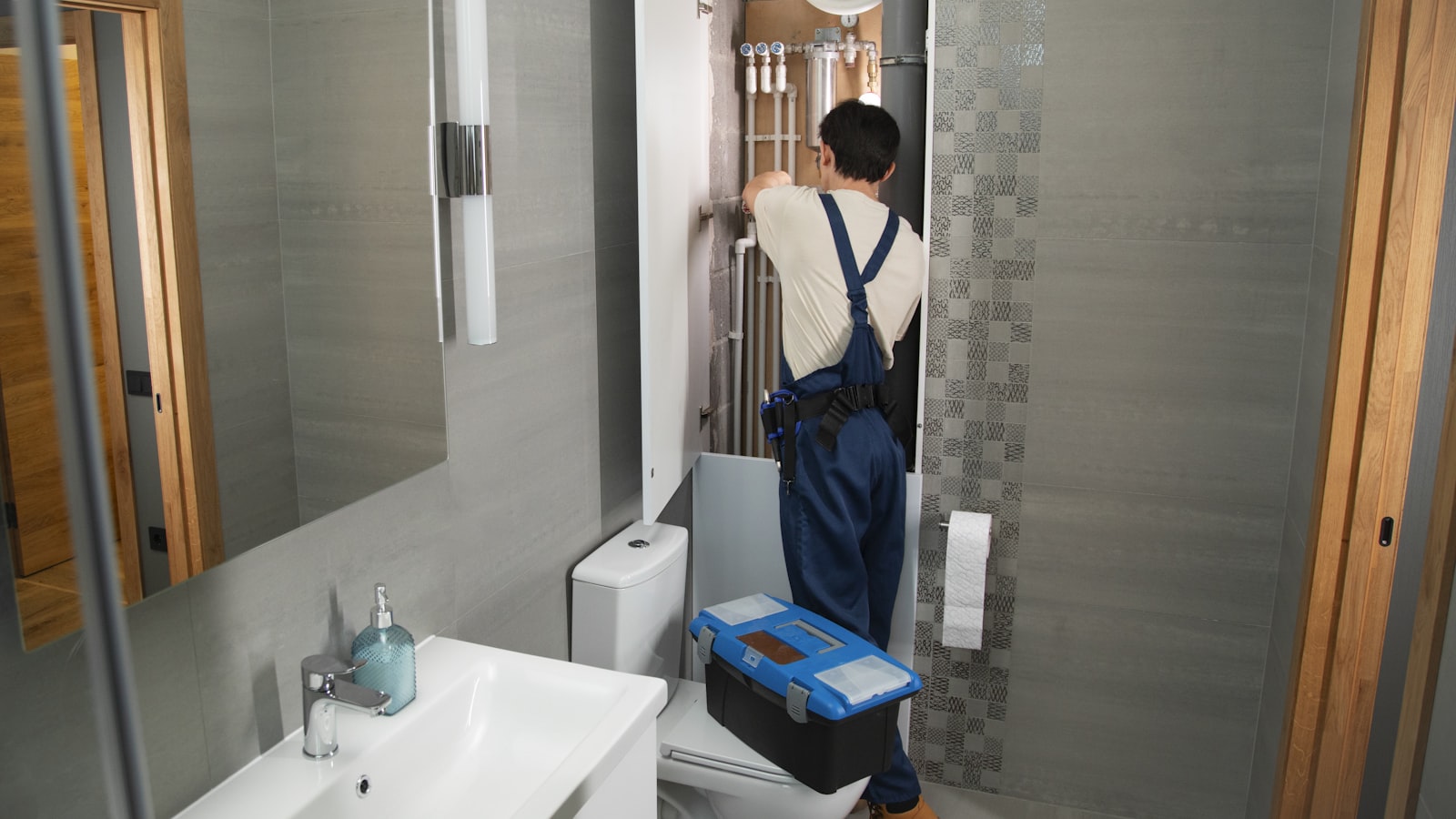
Plumbing has the most predictable revenue mix of any service trade. About a third of jobs are emergency calls (broken water heater, burst pipe, clogged main) where the customer is desperate and price-insensitive. Another third is repair work that follows from a maintenance relationship. The last third is high-margin install work — repipes, water heaters, gas lines. The plumbers who make real money in 2026 don't compete on price for the emergency call; they earn the trust to capture the install work later.
This guide walks every decision in order, with verified 2026 US market numbers. Skip what you've already done; follow sequentially if starting cold.
1. Why plumbing is a strong business to start
What makes plumbing different from other trades:
- **Recession-resilient demand.** Water doesn't stop running because the economy is soft. Burst pipes, broken water heaters, and clogged drains generate work in any economy.
- **Tickets are mid-to-large.** Standard service tickets cluster $200-$900. Water heater install averages $882-$1,816 (Angi). Whole-house repipe in PEX runs $4,000-$15,000. Sewer line replacement averages $3,319.
- **Emergency premium is real.** After-hours / holiday calls bill $150-$250 dispatch and $200-$400 emergency premium — net rate $300-$500/hr per NearbyHunt 2026.
- **State-licensed barrier to entry protects margins.** Plumbing has more apprenticeship-hour protection than detailing or cleaning. The trade is fundamentally less crowded because of licensure.
The realistic income picture: a full-time solo journey-level plumber typically clears $80K-$130K in year-one revenue. Master-licensed operators with established reputations clear $150K-$250K solo. A 2-truck shop in a healthy metro lands $400K-$800K. Sources: Modernize, Jobber 2026 pricing guide.
2. State licensing — the gating credential
Almost every US state requires a state plumbing license, with multi-tier structure: Apprentice → Tradesman → Journeyman → Master. The master license is required to pull permits and qualify a contracting business in most states. Per NEXT Insurance, only Kansas, Missouri, Nebraska, New York (state-level), Pennsylvania, and Wyoming lack a state license — but municipalities in those states almost always set their own (NYC requires a master plumber license at the city level).
| Texas (TSBPE) | Tradesman Plumber-Limited: 4,000 hours + 24-hr course. Journeyman: 8,000 hours + 48-hr course. Master: additional supervised experience + exam |
| California (CSLB C-36) | 4 years journey-level experience in last 10 years. Law/Business + C-36 Trade exams. $25,000 contractor bond. App fee $450; renewal $450 sole owner / $700 non-sole every 2 years |
| Florida (CFC) | 4 years (~7,680 hrs) practical experience, ≥1 year supervisory. Business & Finance + Plumbing Trade exams. Credit report + GL insurance + workers' comp required. 14 hrs CE per renewal |
| Massachusetts | Apprentice: 6,800 hrs + 300 hrs theory over ≥4 yrs. Journeyman: +1 yr (≥1,700 hrs) + 100 hrs advanced theory. Master: ≥1,700 hrs as journeyman + 110-hr Tier 5 program. 12 hrs CE every even-numbered year |
Specialty certifications worth pursuing once you're journeyman+:
- **ASSE 5110 Backflow Prevention.** 40-hr training + 100-question exam (70%+) + practical test on ASSE 1013/1015/1020/1056 assemblies. 5 years documented field experience for full cert. Valid 3 years. Required for irrigation/commercial work in most jurisdictions per Pipe Trades Tech.
- **ASSE 6010 Medical Gas Installer.** Specialty for medical gas/vacuum systems including brazing. 4 years documented plumbing/mechanical experience prereq. ≥32 hrs coursework + practical brazing exam. Valid 3 yrs. Brazer must demonstrate active brazing every 6 months (MGTC).
3. Legal setup beyond the trade license
Once your trade license is in hand, the business-side setup is fast (one weekend, $200-$500).
- **LLC formation** — file with your state's Secretary of State directly. Don't pay LegalZoom $300+ for paperwork that takes 30 minutes. Sample fees: Kentucky $40, Wyoming $100 + $60 annual report, Texas $300, California $70 + $800 mandatory annual franchise tax.
- **EIN** — required for business bank account and hiring. Apply free at IRS.gov. Don't pay third-party sites for the same form.
- **Business license** — most cities $50-$400/year for small operators.
- **Surety bond** — required by most states for the trade license itself. Typical face values: WA $6,000; NJ $3,000 (master); IL up to $20,000; IA $5,000; CA C-36 contractor bond $25,000. Premium 1-5% of bond face per Lance Surety.
4. Equipment + truck setup — three starter tiers
Honest tiers based on Jobber, ZenBusiness, and Financial Models Lab:
Tier 1 — solo bootstrap ($10,000-$20,000)
- Used service van or pickup ($10,000-$20,000)
- Pipe wrenches (12", 18", 24"), basin wrench, channel locks, adjustable wrenches ($300-$500)
- Hand augers (3 ft, 25 ft sink/toilet auger) ($150-$300)
- Pipe cutters (copper + PVC), tubing cutter, deburring tool ($100-$200)
- Soldering torch + flux + solder + heat shield ($150-$300)
- PEX crimper or expander tool kit ($300-$500)
- Threader for galvanized (manual or RIDGID 600) ($300-$1,500)
- Drum drain machine — RIDGID K-400 or similar ($800-$1,200)
- Cordless drill set, work lights, ladder ($500-$1,000)
- Truck inventory: common fittings, valves, supply lines, basic stocked breakers ($1,000-$2,000)
Tier 2 — equipped solo ($30,000-$50,000)
Where most operators settle by year 2.
- Everything in Tier 1, plus:
- Newer service truck or van with shelving package ($25,000-$40,000)
- Pro inspection camera (RIDGID SeeSnake or Milwaukee — $2,500-$10,000)
- Mid-tier sectional drain machine — RIDGID K-1500 ($1,500-$3,000)
- Cordless press tool — Milwaukee M18 ProPex / RIDGID RP 350 ($1,500-$2,500)
- Truck inventory expanded to ~$5,000-$10,000 of stocked parts
- Expanded fitting inventory (PEX, copper, CSST gas, no-hub, ProPress)
Tier 3 — multi-truck shop ($100,000+)
- Trailer-mounted hydro-jetter for sewer/grease ($14,995-$45,000 depending on PSI/GPM per Hydro-Max, HotJet USA)
- Locator equipment for underground line tracing ($1,500-$3,500)
- Multiple service trucks, parts warehouse, small office
- Jetter trucks become economical only at established route density — usually year 2-3
RIDGID dominates drain cleaning, threading, and inspection cameras. Milwaukee + DeWalt are the cordless press / power-tool standards. Klein for hand tools that cross over to electrical work. Cheap pipe wrenches snap; cheap drain machines die. Buy the trade-grade tool once.
5. Pricing your services
Real 2026 US market prices, sourced from Housecall Pro, Angi, Modernize, HomeAdvisor, and HomeGuide:
| Service | Low | Typical | Premium |
|---|---|---|---|
| Service call / dispatch fee | $50 | $75-$150 | $200+ |
| Hourly labor (typical) | $75/hr | $100-$125/hr | $200/hr |
| After-hours / emergency dispatch | $150 | $200-$400 | $500+ |
| After-hours hourly | — | $150-$300/hr | — |
| Drain snake (sink) | $150 | $200-$275 | $400 |
| Sewer line snake (main) | $200 | $300-$500 | $700 |
| Hydro jetting (residential) | $300 | $450-$650 | $2,000 |
| Sewer camera inspection | $125 | $300-$500 | $700 |
| Toilet install | $200 | $350-$600 | $800 |
| Faucet install | $260 | $400-$690 | — |
| Garbage disposal install | $185 | $380-$578 | — |
| Sump pump install | $500 | $1,000-$2,000 | $3,000 |
| Water heater — tank (replace) | $600 | $882-$1,816 avg | $2,500 |
| Water heater — tankless (gas, replace) | $2,700 | $3,500-$5,000 | $5,500 |
| Whole-house repipe — PEX (1,500 sq ft) | $4,000 | $4,000-$6,000 | $15,000 |
| Whole-house repipe — copper (1,500 sq ft) | $9,000 | $10-$12/sq ft | $30,000 |
| Gas line install | $15/ft | $20-$30/ft | $50/ft |
| Sewer line repair/replacement | $1,388 | $3,319 avg | $5,323 |
| Water main repair | $647 | $1,710 avg | $2,833 |
| Membership / maintenance plan | $15/mo | $15-$20/mo | — |
After-hours dispatch is $150-$250; emergency hours bill $200-$400 over standard. Plumbers who eat the premium because they 'feel bad' charging double train customers to call them outside business hours for non-emergencies. Set the rates, post them on your website, charge them every time.
Quote the right water heater in 60 seconds.
Plyrium's quote builder lets you pick the customer's tank size, fuel type, and code-required pan/expansion tank, generate the line-item quote, and text it to their phone. They sign + pay deposit before you order the unit. No more phone tag.
See Plyrium's quote builder6. Finding your first customers
- **Friends, family, and their networks.** Free, immediate, highest-quality first-pass. Offer a discount to your first 5-10 customers in exchange for a Google review and one referral each.
- **Google Business Profile + reviews.** Reviews represent ~16% of local SEO ranking factors per industry data. Plumbers with 25+ reviews convert ~35% higher per ALM Corp 2025. Reach 10 verified reviews to see measurable rank lift; aim for steady velocity (2-3/week) not bursts.
- **Google Local Services Ads (LSA).** Plumber CPL: $25-$45 typical, full range $6-$90, competitive metros $40-$90 (Accelerate Your Marketing, BlueGrid Media). Pay-per-lead with Google Guarantee badge; reviews drive ranking.
- **24/7 emergency positioning.** Plumbing customers in emergencies pick the first business with a real human answering. Even if you don't physically work all hours, having an after-hours dispatch service answer the phone changes acquisition rates dramatically.
- **Wholesaler partnerships.** Ferguson PRO Plus (1,500 welcome points + 1 pt/$1 online + Pro Pick-Up service for 1-hr orders), Home Depot Pro Xtra (free; 15-30% bulk discount tiers, commercial credit). Both also generate referral traffic — the counter staff at your wholesaler hears who's looking for a plumber every week.
- **Plumber-only sub-contracting.** Real estate agents (home inspections that flag plumbing), HVAC contractors (gas line work), kitchen/bath remodelers (rough-in). Often the most stable book in years 2-3.
7. Operations: dispatch, scheduling, payment
The biggest operational mistake new plumbers make: running emergency dispatch on personal cell phone + paper notepad. It works at 5 customers/week and falls apart at 20+.
Minimum operations stack:
- **24/7 phone answering** — even if you're solo. Either an AI receptionist (the cheap path) or a human answering service (the expensive path). Calls that go to voicemail at 11pm convert at <10%; calls answered live by anyone convert at 60%+.
- **A calendar customers can book directly into.** Reduces phone tag for the 70% of jobs that aren't true emergencies.
- **Automated SMS reminders 24h before service** — cuts no-shows from 20%+ to <5%.
- **Mobile payment processor on-site** — Square, Stripe Terminal, or your software's built-in. Customers paying card-on-file at completion is 4× faster than 'we'll send you an invoice.'
- **Customer records that survive your phone dying.** Every job's address, scope, parts used, and photos go into one searchable database — not a notes app on your phone.
8. Build recurring revenue with maintenance plans
Plumbing maintenance plans are smaller-ticket than HVAC ($15-$20/month vs $20-$40/month) but the customer-retention math is the same: a member calls YOU first when their water heater dies, not the next Google ad they see.
| Price | $15-$20/month ($192-$243/yr) |
| Includes (typical) | 1 annual whole-home plumbing inspection + repair discount (10-15%) + waived/reduced after-hours dispatch fee + priority scheduling + camera inspection of one drain per year |
| Why it works | The annual inspection finds 2-3 small repairs that would have become emergencies later. Customer is grateful + you are paid for finding them. |
| Math | 100 active members × $20/mo = $2,000/mo recurring; the repair work the inspections generate typically runs 3-5× that figure |
Maintenance plan billing without the busywork.
Plyrium's recurring service contracts handle the boring side: autopay through Stripe, auto-scheduled annual inspections, customer cards on file with self-service updates. When a card fails, Plyrium emails the customer with a payment link — you don't chase. Plus an AI receptionist that answers 24/7 so emergency calls don't go to voicemail.
See recurring contracts in Plyrium9. Insurance — what you actually need
Cost benchmarks from Insureon 2026, NEXT, and Kickstand:
| General liability ($1M/$2M) | $115/mo or $1,378/yr avg (Insureon). NEXT $75/mo (range $58-$314). |
| Commercial auto | $225/mo or $2,704/yr avg (Insureon) |
| Workers comp (NCCI 5183) | $3.05 per $100 of payroll avg. Plumbers pay ~$195-$211/mo on average per employee (Kickstand) |
| Surety bond (state-required) | $3,000-$25,000 face value. Premium 1-5% of bond face. Examples: WA $6K, NJ $3K, IL up to $20K, IA $5K, CA $25K |
Total annual insurance + bond stack for a 1-person operation: $3,000-$8,000. For a 2-3 person crew: $8,000-$15,000. Plumbers running gas line work or boiler installation pay 30-50% higher GL premiums than service-only operators.
10. Regulatory gotchas
Permits
Most jurisdictions require permits for any work that alters supply, waste, or gas lines, replaces water heaters/treatment equipment, or affects public water/sewer connections. Like-for-like working-parts repairs (faucet/valve internals) are commonly exempt. Owner-occupant exemptions exist in some jurisdictions for personal residences (not rentals). Confirm city/county AHJ for each job.
Lead-free fixture compliance (federal)
Safe Drinking Water Act §1417 defines "lead free" as a weighted-average 0.25% lead across wetted surfaces of pipes/fittings/fixtures and 0.20% for solder/flux. The Reduction of Lead in Drinking Water Act (RLDWA) lowered the wetted-surface threshold from 8% to 0.25%. EPA's final rule "Use of Lead Free Pipes, Fittings, Fixtures, Solder, and Flux for Drinking Water" published Sept 1, 2020 (40 CFR Part 143 Subpart B); manufacturer/importer certification of compliance required within 3 years of publication. Exemptions: toilets, bidets, urinals, fill/flushometer valves, fire hydrants, tub fillers, shower valves, service saddles, and water main gate valves ≥2".
Cross-connection / backflow
Required by state under SDWA framework. Public water suppliers must run a Cross-Connection Control Program. **Reduced pressure zone (RPZ) assemblies** require testing on installation, repair, relocation, AND annually. Double check valves and PVBs also typically require annual testing. Annual test reports are usually due to the water utility. ASSE 5110 backflow certification (covered in Section 2) is required to perform these tests in most jurisdictions.
There's no dollar threshold that flips a 1099 contractor into a W-2 employee. The IRS uses a behavioral / financial / relationship test. For plumbers: setting the helper's schedule, providing supplies, training them on your methods, ongoing relationship — those push toward W-2. Misclassification penalties include back employment taxes + FICA share + FUTA + interest + potential FLSA overtime claims for the entire tenure. The DOL and IRS announced renewed enforcement on this in 2024-2025.
11. Your first 30 days — concrete plan
If you have your journeyman license + state bond and you're starting today:
| Week | Focus | Outcome |
|---|---|---|
| Week 1 | Legal + insurance + bond | LLC filed, EIN obtained, business bank account open, GL ($1M) + commercial auto + state bond bound. ~$3,000-$6,000 spent. |
| Week 2 | Truck + tools + supplier accounts | Used service truck purchased + outfitted. Tier-1 tool kit acquired. Ferguson PRO Plus + Home Depot Pro Xtra accounts opened. ~$15,000-$30,000 spent. |
| Week 3 | First five customers (discounted) | Friends, family, and one or two from your local neighborhood Facebook group at 20% off in exchange for honest reviews and one referral each. Practice your service-call workflow. |
| Week 4 | Public launch + after-hours phone | Google Business Profile live with 5+ reviews. Google LSA campaign live ($300/wk to start). 24/7 phone-answering set up (AI or service). First paying public customer. |
Realistic expectation: 4-9 months to consistent full-time income for a solo plumber. The plumbers who blow up first-year are almost always the ones who didn't carry their tax money — set aside ~25-30% of every payment in a separate account from day one. Plumbing pay from a single big sewer job can dwarf a month of service work; don't spend the tax-money portion.
Plumbing rewards mechanical skill, code knowledge, and customer trust over scale or aggression. Show up on time. Answer the phone after hours. Charge fairly for the emergency premium. Don't compete on price — compete on response time, professionalism, and explaining what you actually fixed.
Run your plumbing business with Plyrium
CRM, scheduling, quotes, invoices, recurring service contracts, and an AI receptionist — built for service-trade contractors. 14-day free trial. No setup fee. No long-term contract.
Start free trial