How to add commercial accounts to a pressure washing business in 2026
Three commercial upsell paths that share a rig and a buyer (commercial property managers): fleet washing, building soft wash, and flatwork. What each pays, what it actually costs to enter, and the EPA + insurance reality that gates the work.
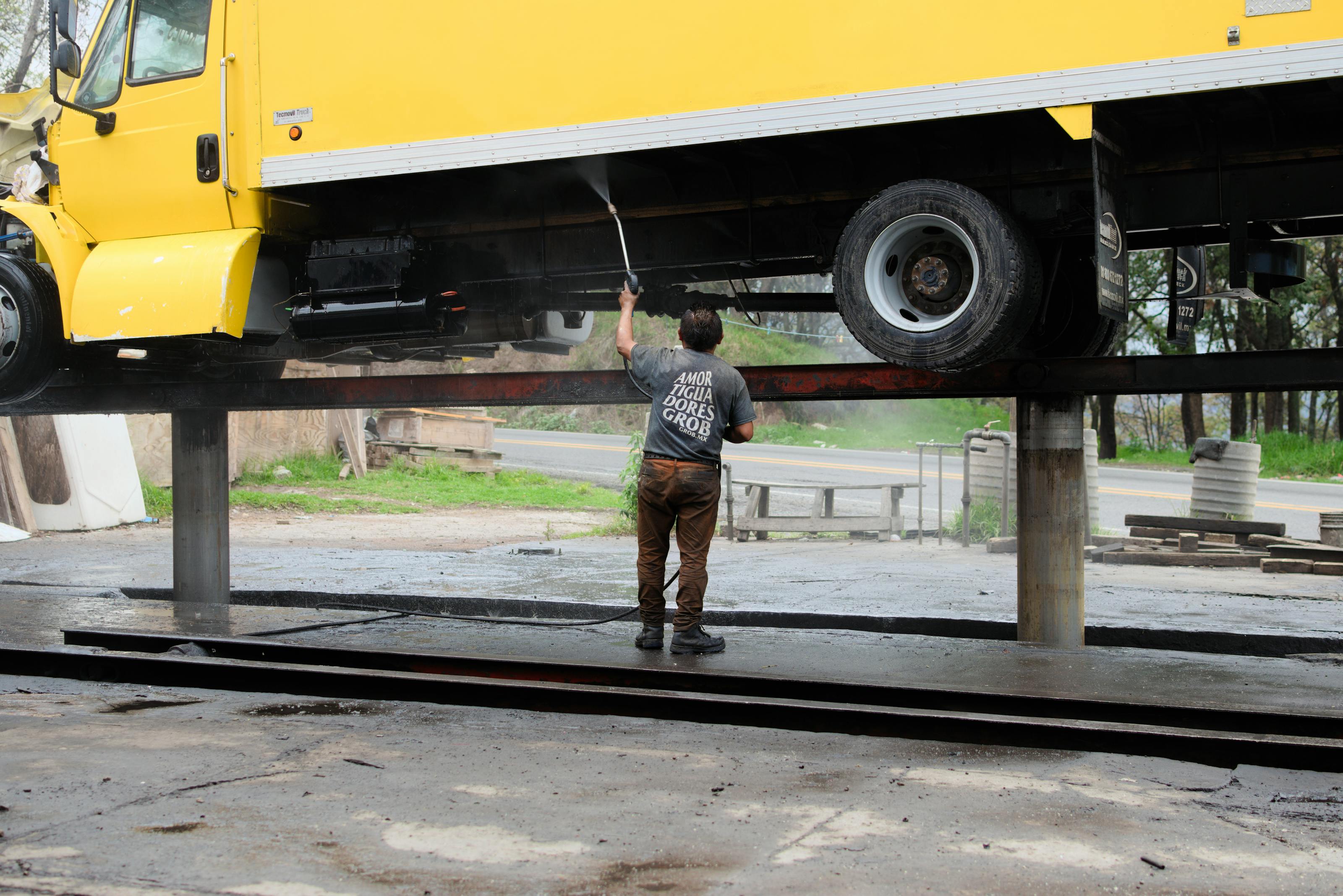
Residential pressure washing is a great starter business — low entry cost, no certifications, immediate cash flow. It's also a one-shot business. A homeowner gets their driveway washed every 2-3 years. A commercial property manager rotates contractors on price. Most residential pressure washers cap out at $150K-$300K of annual revenue per truck because the work is project-based and seasonal.
**Commercial accounts convert that project business into a route business.** Fleet operators wash trucks weekly to bi-weekly. HOAs and office property managers schedule annual or biannual building soft washes. Parking-lot and forecourt clients sign monthly contracts. Same rig, same chemistry, same skills you already use on residential work — but the customer (commercial property manager) is durable, the scope is recurring, and the unit economics are materially better.
This guide is for the operator who already has a profitable residential pressure washing business and wants to graduate. We cover three commercial paths that all sit inside the pressure-washing wheelhouse — **fleet washing, commercial soft washing, and flatwork** — plus the shared regulatory framework (Clean Water Act, FIFRA, ARMA roof-cleaning standards) and insurance overlay (Contractors Pollution Liability, $5M umbrella) that gates the work in 2026. If you're starting from zero, read How to start a pressure washing business from scratch first — commercial accounts assume you already know how to run a pressure washer profitably.
The shared framework — one rig, one buyer, one regulatory regime
All three commercial upsells share the same operating substrate, which is why they belong in the same conversation:
- **One rig.** Hot-water trailer-mounted skid (4-8 GPM, 3,500-4,000 PSI, diesel-fired burner, 200-500 gal water tank) does fleet, soft wash, and flatwork. The capital investment ($15K-$45K all-in for a serious commercial rig) amortizes across all three revenue streams.
- **One buyer.** Commercial property managers want a single vendor for the whole property's exterior maintenance — fleet vehicles, building exteriors + roofs, parking lots + sidewalks. A contractor who can quote all three wins the master service agreement; a contractor who only does one piece gets sub-contracted at thinner margin.
- **One regulatory regime.** EPA Clean Water Act §402 + 40 CFR 122.26(b)(2) prohibit unpermitted discharge of commercial wash water (loaded with detergents, hydrocarbons, brake dust, sodium hypochlorite) to municipal storm sewer systems. Same federal framework applies whether you're rinsing a semi-tractor, a building wall, or a parking lot.
Per the EPA Civil Monetary Penalty Inflation Adjustment effective Jan 8, 2025 (90 FR 1372; codified at 40 CFR §19.4), the CWA §309(d) judicial civil penalty is **$68,445 per day, per violation** — a long way from the legacy $25,000 figure many operators still quote. Administrative Class I penalties run $27,378/day to $68,445 max; Class II up to $342,218 total. Realistic enforcement against a small contractor is more often municipal MS4 ordinance fines ($500-$5,000 per occurrence), customer loss, and citizen suits under CWA §505 — but the federal exposure is real, and "the customer's parking lot drains to a storm grate" is a problem you have to solve before bidding the job, not after.
Path 1 — Commercial fleet washing
Fleet washing (trucks, trailers, construction equipment) is the fastest-cash commercial entry. Cold water cuts house siding fine — it does not cut diesel road film, axle grease, or brake dust off a tractor-trailer in commercially viable dwell time. **Hot water at 180-200°F emulsifies petroleum hydrocarbons through saponification.** Every fleet rig is hot-water; bid fleet without hot-water capability and you'll either burn 3× the chemical to compensate or deliver a half-cleaned truck and lose the account.
| Entry hot-water skid (3,000 PSI / ~5 GPM, diesel burner) | $4,500-$7,000 (e.g. Hydro Tek SS-series) |
| Refurb mid-range trailer rig (5 GPM, 210-gal tank, 5×8 trailer) | ~$10,000 observed dealer pricing |
| New 4-8 GPM trailer-mounted (tank, reel, burner, frame) | $15,000-$45,000 depending on configuration |
| Used market (3-5 yr old, good condition) | ~40-60% of new price |
Verified hot-water OEMs serving the U.S. fleet market in 2026: **Hotsy** (Karcher subsidiary, 175+ N.A. service centers), **Landa** (Karcher subsidiary), **Hydro Tek** (Redlands, CA), **Alkota** (Alcester, SD; independent — not Karcher), **Mi-T-M** (Peosta, IA), **Cam Spray**. Get quotes from at least three before buying — list price varies 15-25% on the same spec depending on dealer markup.
Wash water reclaim — non-negotiable for fleet
The compliant ways to handle commercial fleet wash water under CWA §402:
- **On-site capture + sanitary disposal.** Inflatable berm or vacu-boom containment + sump pump moves wash water into a holding tank; tank is offloaded at a sanitary sewer connection (with publicly-owned-treatment-works permission) or hauled to a wastewater facility.
- **On-site capture + filtration + landscape discharge.** Multi-stage filtration (oil/water separator + cartridge polish) cleans water to landscape-discharge standards with adequate setback from storm drains.
- **Customer-site infrastructure.** Some larger fleet yards (LTL terminals, municipal bus barns, distribution centers) already have dedicated wash pads with sanitary sewer connection.
| Vacu-Boom recovery tube (5" flexible, 20-ft section) | $200-$400 each |
| Portable berm + recovery vacuum kit | $3,000-$10,000 |
| Closed-loop reclaim trailer (oil/water separator + filtration) | $40,000-$120,000+ (quote-only; varies by configuration) |
Verified reclaim OEMs: **Riveer** (Watervliet, MI — military-grade fixed installations + mobile), **Hydro Tek Reclaim line**, **Water Maze** (a Karcher water-recovery brand), **ESD Waste2Water**. A $10K mobile reclaim unit pays itself off in 3-6 months on the 2-3 fleet accounts that won't sign without it.
| Unit | Per-wash range | Notes |
|---|---|---|
| Box truck / cargo van | $35-$65 | Local delivery, plumbing/HVAC fleets |
| Semi-tractor (cab only) | $50-$85 | Lower at large-fleet scale (50+ trucks weekly) |
| Full tractor-trailer combo | $80-$150 | Most common quoted unit |
| Construction equipment (excavator, loader) | $90-$150/hour billable | Varies with caked-mud condition |
| Reefer trailer interior (separate sanitation) | $25-$75 | Different chemistry; often sub'd |
Power Washers of North America (PWNA) New Member Bundle is $399 for a 1-year contractor membership + 1 convention pass. PWNA offers fleet-wash and environmental certifications that carry weight on commercial bids. Worth joining once you're committed to commercial; not worth optimizing for before your first commercial account. The 2026 PWNA convention is "Elevate 2026" per Cleaner Times.
Path 2 — Commercial soft washing (buildings + roofs)
Soft washing is sodium-hypochlorite-based exterior cleaning at low pressure (0-100 PSI rinse) — different chemistry from mechanical pressure washing, same rig (with a chemical-injection downstream applicator). **HOAs, condos, office buildings, multi-family housing, and any commercial roof under shingle warranty are the natural soft-wash market.** Same residential house-wash skill set, just applied at commercial scale on a recurring contract.
ARMA + the manufacturer-warranty reality
Commercial roof cleaning is gated by the Asphalt Roofing Manufacturers Association (ARMA) technical bulletin "Algae & Moss Prevention and Cleaning for Asphalt Roofing Systems". Verbatim ARMA guidance:
- **Mix:** 50:50 mix of laundry-strength liquid chlorine bleach (~5-6% sodium hypochlorite) and water — yields approximately 2.5-3% applied SH
- **Application:** spray, allow 15-20 minutes dwell on the roof surface
- **Rinse:** rinse thoroughly with **low-pressure** water
- **Pressure prohibition:** "Never use a pressure washer to clean an asphalt shingle roof as this will cause granule loss and very likely premature failure of the roof system"
GAF's Technical Bulletin R-102 "Algae Staining on Shingled Roof Surfaces" recommends a low-pressure bleach/TSP/water solution and explicitly advises against power washing. Owens Corning and CertainTeed publish similar guidance — all three follow ARMA. **Pressure-washing a shingle roof voids the manufacturer warranty.** A property manager whose new roof has 25 years of warranty left will not re-hire the contractor who voided it. Soft wash is the only ARMA-compliant process for asphalt-shingle roofs, period.
The chemistry side
**12.5% sodium hypochlorite (SH, "pool shock concentrate")** is the soft-wash industry input. Operators dilute to 1-4% applied SH depending on substrate (vinyl siding tolerates higher; brick + stucco need lower). Surfactant additives (**Cling-On** from EaCo Chem, **Apple Wash**) extend dwell time on vertical surfaces and improve cleaning power without raising SH concentration.
| 12.5% SH bulk (pallet/tote quantities, NSF-listed) | $2-$3 per gallon (e.g. Waterline Technologies, CoreChem) |
| 12.5% SH single-gallon retail | $4-$7+ per gallon at distributors |
| Cling-On surfactant (1-gal) | ~$50-$80 |
| Downstream chemical injector (rig add-on) | $50-$300 depending on flow rate |
Per EPA's Determining If a Cleaning Product Is a Pesticide Under FIFRA: bleach is NOT a pesticide UNLESS the seller or applicator makes a pesticidal claim. "Soft wash kills algae and mildew" or "kills mold" in your marketing copy can re-classify your product AND your work as pesticide application — at which point a pesticide-applicator license is required (varies by state). North Carolina and Illinois actively enforce this against soft-washers making such claims; Florida has historically treated SH-based exterior cleaning as a cleaning service when no pesticidal claim is made. **Marketing rule of thumb: "removes algae and mildew stains" is fine; "kills algae and mold" can trigger licensing.** Confirm with your state's department of agriculture before publishing any kills/sanitizes language.
| Surface | Range | Notes |
|---|---|---|
| Building exterior soft wash (single-story) | $0.15-$0.30/sq ft | HOA/condo single-level, vinyl/composite |
| Building exterior soft wash (multi-story) | $0.30-$0.75/sq ft | Access cost + height premium |
| Mixed-use / office building exterior | $0.30-$0.90/sq ft | Substrate + access drive price |
| Asphalt-shingle roof (ARMA-compliant) | $0.30-$0.75/sq ft | Includes 50:50 mix application + low-pressure rinse |
| Tile or metal roof soft wash | $0.40-$1.00/sq ft | Substrate-specific chemistry |
Path 3 — Commercial flatwork (parking lots, decks, sidewalks)
Flatwork is the volume side of commercial pressure washing — parking lots, multi-level parking decks, fuel-station forecourts, sidewalks, dumpster pads, drive-throughs, gas-station islands. Property managers schedule monthly to quarterly. Hot-water rig from your fleet operation pays double-duty here, and surface cleaners (the round 24-36" attachment that runs flat over concrete) turn an 8-hour parking lot into a 2-hour parking lot.
Surface cleaner equipment
Surface cleaners are the productivity multiplier on flatwork — verified 2026 retail pricing from MPWSR Whisper Wash collection:
| Whisper Wash Ground Force 24" | from $1,316.67 |
| Whisper Wash Big Guy 28" | from $1,428.83 |
| Whisper Wash Maxima 36" | $2,240.67 |
| Mosmatic premium (Swiss) | comparable to Whisper Wash; premium models $3,500+ |
| General Pump | comparable mid-range pricing |
| Surface | Range | Notes |
|---|---|---|
| Parking lot (per square foot) | $0.03-$0.20/sq ft | Per HomeGuide 2026 |
| Parking lot (per parking space) | $8-$20 per space | Quick-quote alternative to per-sf |
| Concrete sidewalks / driveways | $0.10-$0.30/sq ft | Standard residential-grade rate at commercial scale |
| Dumpster pads | $0.25-$1.00/sq ft | Wide range due to grease load |
| Multi-level parking decks | Bid by job | No single per-sf rate; access + drainage drive cost |
| Fuel-station forecourts | Bid by job | Petroleum recovery + AHJ coordination required |
Fuel-station + parking-deck stormwater compliance
Fuel-station forecourts and multi-level parking decks generate wash water with petroleum, brake dust, antifreeze residue, and detergents. Most state stormwater programs require discharge to contain ≤15 ppm oil & grease (24-hour composite, based on the CWA "no sheen" standard). Vehicle-fueling/repair sites typically must apply for state stormwater operating permits. Best practice per EPA Oil/Water Separator guidance, Chapter 5:
- **Capture/vacuum wash water on-site**, haul to permitted treatment facility — most defensible.
- **Discharge through customer's oil/water separator** with documented BMPs in their SWPPP (Stormwater Pollution Prevention Plan).
- **Coordinate with the local fire marshal** before fuel-station work — UST/AST regulations on hydrocarbon recovery vary by jurisdiction.
- **Discharge to landscape** is sometimes acceptable for low-load substrates (sidewalks, condo flatwork) but is NOT blanket-permitted. Local stormwater authority decides.
Run residential + commercial books in one place
Plyrium handles the recurring-service contracts (monthly parking-lot routes, quarterly building soft washes, weekly fleet routes), the AI receptionist that captures "my parking lot needs cleaning" property-manager calls after hours, and quotes/invoices/payments through one dashboard. Same software that runs your residential side handles the commercial side without you switching tools.
See pricingInsurance — the policies most residential pressure washers don't carry
Insurance for commercial work is materially heavier than residential. Plan for:
- **General liability:** $1M per occurrence / $2M aggregate is the residential floor. Commercial property contracts typically demand **$2M/$4M**, and large MSAs (REIT-owned property managers, national portfolio operators) commonly require a **$5M umbrella** atop the GL.
- **Contractors Pollution Liability (CPL) rider:** $300-$1,200/year for $1M limits in 2026 per typical pressure-washing premium quotes. Required when contracts involve hydrocarbon, sodium hypochlorite, or any substance entering soil or MS4. **Standard general-liability policies exclude pollution events** — the CPL endorsement is what makes commercial fleet, soft-wash, and forecourt work insurable.
- **Workers' comp:** required in 49 of 50 states (Texas exempts sole-prop with no employees). Most NCCI states default to **Class Code 9014** (Janitorial Services by Contractors—No Window Cleaning Above Ground Level), but many carriers will not write power-wash exposure under 9014 and decline the risk entirely. California (WCIRB) and New York (NYCIRB) have their own class-code systems. **Confirm with your carrier; don't assume a single code applies in every state.**
- **Commercial auto + Inland Marine on the rig:** trailer + equipment value $30K-$80K. Schedule the rig as inland marine (or as a commercial-auto equipment endorsement) — your auto policy alone usually doesn't cover the equipment, only the truck.
Property-manager contracts — what the paper actually says
Commercial property-manager contracts (the durable revenue side of pressure washing) follow industry-typical economics:
- **Term:** 12-month with auto-renew is standard. Some national portfolio managers prefer 24- or 36-month with annual review.
- **Pricing escalator:** 3-5% annual or CPI-tied is industry-typical. Don't sign a multi-year fixed-price contract — fuel + chemistry costs move every year.
- **Payment terms:** net-30 to net-60 typical. Large national property managers push net-45 or net-60. Build cash-flow assumptions accordingly.
- **Termination:** 30-day mutual notice is industry-standard. Short notice protects you if fuel costs spike; the same notice protects them if you no-show.
- **Insurance requirements (in the contract):** named insured / additional insured endorsements, certificates of insurance (COI) refreshed annually, immediate notification of policy changes. Most MSAs require your COI on file before the first service date.
First 90 days — building the commercial pipeline
- **Days 0-30 — Capital + insurance.** Hot-water rig (if you don't already have one) plus chemical-injection downstream applicator + 24-28" surface cleaner = $5K-$15K added to a residential setup. Upgrade GL to $2M/$4M; add CPL $1M; schedule rig on inland marine. Verify your COI is on file with current language.
- **Days 30-60 — Identify the pipeline.** Build a list of 30+ prospect commercial property managers in your service area: HOA management companies (Associa, FirstService Residential, etc.), commercial property managers (CBRE, JLL, Cushman & Wakefield managed properties), fleet yards (LTL trucking, plumbing/HVAC fleets, construction equipment dealers), gas-station chains. LinkedIn + state property-manager association directories. Reach out with specific service offers ("I do quarterly building soft wash + monthly parking-lot cleaning"), not generic intros.
- **Days 60-90 — Land the first 3 commercial accounts.** First fleet account validates the rig + reclaim workflow. First soft-wash account validates the ARMA-compliant chemistry. First flatwork account validates the surface-cleaner production rate. Three accounts at $1,500-$3,000/month each = $54K-$108K of locked-in annual revenue, on top of your residential book.
Next step
Commercial accounts are how a $150K-$300K residential pressure washer becomes a $400K-$1M+ commercial operation. The capital + insurance + regulatory gates are real, but they're also why the work pays — most local residential operators won't make the leap, which thins the local commercial field from 200+ residential pressure washers to 5-10 serious commercial operators per metro. Three recurring property-manager accounts compound; six become a route business; twelve become a hire-a-second-tech business.
What separates the operators who build durable commercial books from the ones who burn out is operational discipline — recurring schedules tracked in software, professional documentation per visit, ARMA-compliant roof process every time, no pesticidal-claims marketing copy that triggers state pesticide-applicator licensing. Run that on Plyrium and the recurring side stays disciplined while you sell.
Run your pressure washing business with Plyrium
CRM, scheduling, quotes, invoices, recurring service contracts, and an AI receptionist — built for service-trade contractors. 14-day free trial. No setup fee. No long-term contract.
Start free trialRelated guides
How to Start a Pressure Washing Business from Scratch (2026 Guide)
Honest playbook for starting a pressure washing business in 2026. Solo operators run 60-75% gross margin / 40-50% net at scale; 32,193 US businesses competing for $1.2B in revenue. The startup is genuinely cheap ($1,000-$5,000 lean, $15K-$30K trailer rig); the wins come from soft-wash chemistry knowledge, EPA-NPDES wastewater compliance, and the brands that distinguish pros from weekend warriors.
How to Write a Service Contract That Holds Up (2026 Guide)
The honest playbook for service-trade contractors: state-required clauses (CA / NY / MA / TX / FL), the FTC Cooling-Off Rule that catches kitchen-table sales, deposit caps that vary by state, change-order discipline, and the dispute-resolution clauses courts will actually enforce.
How to Deal with Non-Paying Customers (Including Lien Rights) — 2026 Guide
Honest collections playbook for service contractors: the FDCPA rules that apply to YOU vs third-party collectors, state-by-state mechanic's lien deadlines (CA 90 days, TX 15th-of-3rd-month, FL 90 days), the demand-letter cadence that actually collects, and when to walk away vs file suit.